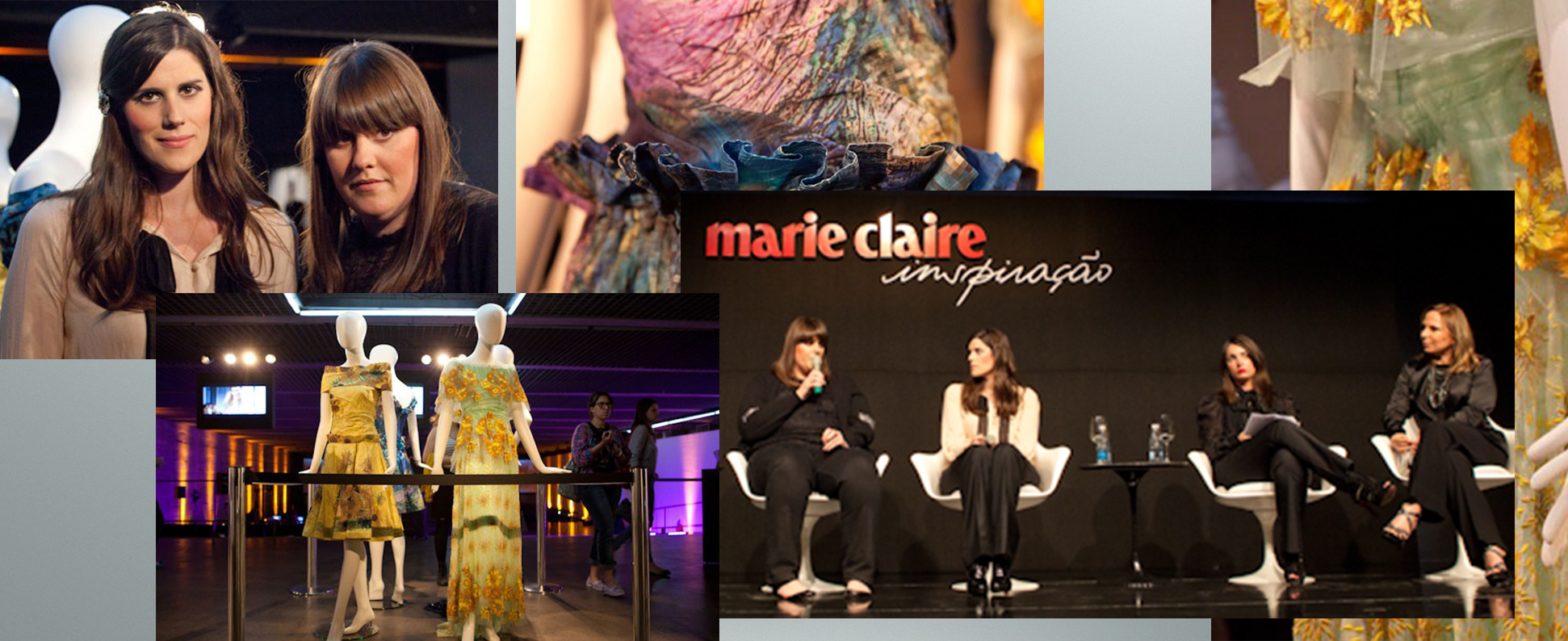
Rodarte in São Paulo: "Why do not we have more fashionable dreamers?"
On Monday evening (24.10), the Brazilian Sculpture Museum in São Paulo hosted the third edition of Marie Claire Inspiração, a seminar promoted by "Marie Claire" magazine, which this year brought sisters Kate and Laura Mulleavy, of Rodarte. On stage, besides the stylists, were Paulo Borges, CEO of Luminosidade; Monica Serino and Sandra Bittencourt, respectively editor-in-chief and fashion editor of "Marie Claire"; and Cris Nicklas, who acted as mediator of the conversation and questions of the audience.
Sympathetic but well into theirs, Kate and Laura Mulleavy started talking about their working method, including their partnerships, as in the case of the collection launched with Target in 2009 and the costumes they created for the film "Black Swan" (2010 ): "We've been discovering different ways of working with different teams and products, but we've found that it works when we create stories on which we can base our choices, and we talk about ideas that we think can be powerful," said Laura. In the case of the film, the designer said that they had "a lot of freedom, which I think is unusual in creating costumes, but Darren [Aronofsky, director of the film] wanted a strong visual language, and we combined beauty and delicacy of ballet with something more brutal. It was pretty intense. " Kate added: "Although we had a lot of freedom, it was a very definite character; one of the challenges was to create iconic costumes that would make the audience believe that all that effort and all that transformation was worth".
Regarding her views on fashion, since her works are often described as works of art and have already been exhibited in museums, Kate said: "It's an interesting question, and we're questioned about it a lot because if a person does not know us , and you do not know our work, but you hear us talking about what we're doing, she might think we're talking about a movie, a short, or an installation. " Laura said she believed that fashion "is a way of understanding culture," and that "you can understand the story by the way people dress - it's one of four things that helps you understand what was going on 10 years ago." Kate then said: "Maybe the question is not whether fashion can be art and vice versa, but why we do not have more fashionable dreamers. Our collections are very personal, and we convey something using fashion as a medium, and I think that's what happens to many artists".
About her work dynamics, Kate revealed that "it's almost like one person, we never have separate ideas that we then share; it's something we're developing together, "and then laughing," Laura is more focused, and I'm more dispersed, the one who has ideas for 300 new parades that have nothing to do with what we're doing".
Her work philosophy, perhaps the element that explains Rodarte's sudden (and continuous) success, is exposed when she is questioned about the world crisis, especially the American crisis, and the effects it may have on the brand: "We always create because there is no other option for us. I wake up in the morning and I want to create, that's what motivates me - at the same time that we did not know anything about fashion. Fashion has never been a clear path for us. We went to New York with our creations and thought it was the worst decision we had ever made; we made phone calls and no one wanted to see us until somehow the WWD called us and wanted to see us and see us on the cover of the publication the day before Fashion Week. We put creativity first, with integrity and identity. Now, with this crisis, that mentality is more important than ever."
| Date: | 2011 |